2026 Top Heat Pump Heater Types for Global Buyers
For global buyers, choosing a Heat Pump Heater is less about following a trend and more about matching equipment to a building, climate, and energy supply. The International Energy Agency’s The Future of Heat Pumps (2022) reported that global heat pump sales grew by nearly 11% in 2022, while sales in Europe rose by around 40%. These figures show strong momentum, but they do not guarantee the same savings in every home or commercial site. Local winter temperatures, electricity prices, insulation, and installer expertise all matter.
The main options include air-source, ground-source, and water-source heat pumps, alongside hybrid systems that pair a heat pump with another heater. An air-source unit can suit many existing buildings, though cold-weather performance and defrost cycles deserve attention. Ground-source systems use buried loops and can offer steadier temperatures, but excavation adds cost and complexity. Water-source models depend on a suitable water source and careful site assessment. Details matter. A correctly sized unit should provide reliable comfort without frequent cycling; poor design can undermine even efficient equipment. The IEA’s Global Energy Review 2024 also highlights that heat pump deployment varies across regions, reinforcing the need to assess local conditions rather than rely on global averages. This guide compares leading heater types for 2026 buyers, including their practical strengths, trade-offs, and questions to ask suppliers. Some comparisons remain imperfect: product performance depends on installation and operating conditions, not just headline ratings. A careful shortlist is a better starting point.
Heat Pump Fundamentals: IEA Reports 3–5 Units of Heat per Unit of Electricity
For buyers comparing heat pump heater types, the efficiency figure deserves a closer look. The International Energy Agency’s 2022 report, The Future of Heat Pumps, says heat pumps can deliver around three to five units of heat for each unit of electricity consumed. In practical terms, one kilowatt-hour of electricity may provide three to five kilowatt-hours of heat. That is a measure of heat moved, not created.
Conditions matter. An air-source unit may work harder when outdoor air is very cold, while high water temperatures can also reduce efficiency. Ground-source systems draw on steadier underground temperatures, but installation needs suitable space and careful design. Small details count: radiator size, pipe settings, insulation, and the thermostat schedule. That neat ratio can mislead. It describes typical performance, not a promise for every home or climate. Buyers should compare seasonal performance figures, such as SCOP, and check what temperatures and test conditions those figures assume. The IEA’s range is useful context, but local operating data is better evidence. A poorly matched system can disappoint, even when its brochure looks efficient.
Ground-Source Heat Pumps: Assess Seasonal Efficiency and Ground-Loop Design
2026 Top Heat Pump Heater Types for Global Buyers
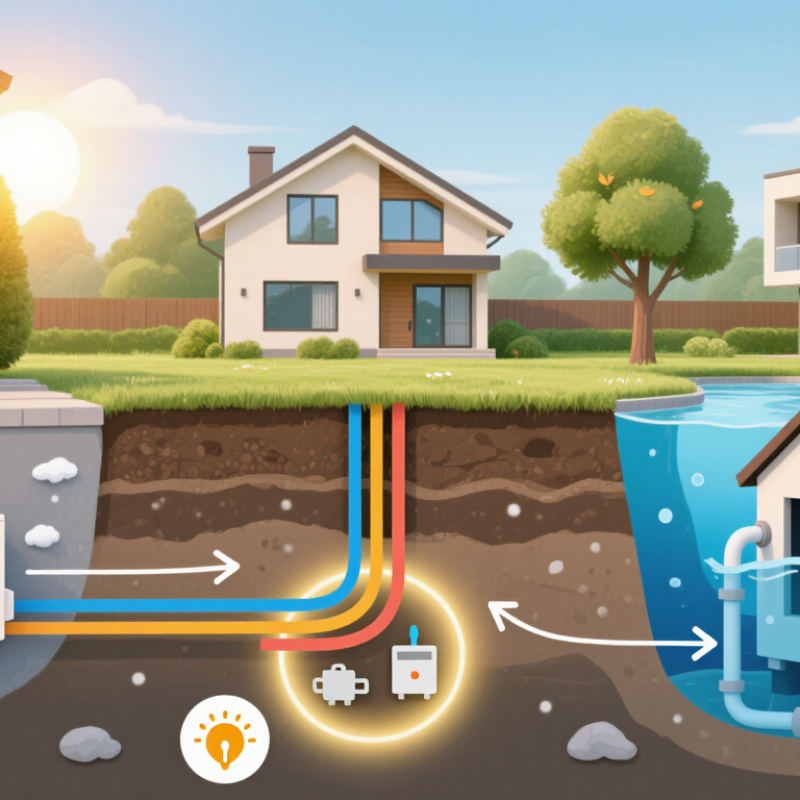
Ground-source heat pumps draw heat from soil or groundwater, where temperatures change slowly throughout the year. Their seasonal efficiency depends on more than a laboratory COP. Designers should review SCOP, entering water temperature, heating demand, cooling demand, and local electricity conditions. A high rating can mislead when the ground loop is undersized.
Loop design starts with a site survey. Soil conductivity, moisture, rock layers, land area, and drilling access all affect performance. Horizontal loops may suit open land and shallow installation. Vertical boreholes need less surface space but require careful spacing and depth calculations. Poor spacing can create thermal interference, especially after several hot summers.
The system also needs balanced heat exchange. A building that only extracts heat may gradually cool the ground. Cooling loads can restore some energy, but not always. Engineers should model monthly loads rather than rely on annual averages. Flow rates, pipe pressure, antifreeze concentration, and manifold access deserve attention during commissioning. Small installation errors matter.
Field checks can reveal unexpected issues. A loop may meet its design length but still deliver weak temperatures because the soil model was too optimistic. Groundwater movement can improve heat transfer, yet it can also complicate drilling and permits. Buyers should request measured performance data, maintenance records, and a transparent loop calculation before approving equipment.
2026 Top Heat Pump Heater Types for Global Buyers
Ground-Source Heat Pumps: Seasonal Efficiency by Ground-Loop Design
Typical seasonal coefficient of performance (SCOP) values are shown as representative engineering ranges for properly designed ground-source heat pump systems. Vertical closed-loop systems often provide stable performance where land is limited, while horizontal loops may reduce installation complexity when sufficient land is available. Actual results vary with soil or rock conditions, climate, entering-water temperature, system sizing, and loop design.
Data are technology-level reference values rather than company or brand specifications. SCOP represents the seasonal ratio of useful heating output to electricity consumed.
Water-Source Heat Pumps: Match COP and Capacity to Available Water Sources
Water-source heat pumps can deliver strong efficiency, but COP depends on the water available at the site. The U.S. Department of Energy reports that geothermal systems can reach efficiencies three to six times higher than conventional heating systems. That figure is useful, not universal. Groundwater at 12°C behaves differently from a shallow pond that cools sharply in winter.
Match the unit to entering-water temperature, flow rate, and seasonal stability. A system rated at COP 4.5 may lose capacity when water temperature falls or filters collect sediment. For example, a 100 kW heating load may require more than 100 kW of nominal equipment capacity during cold water conditions. Check the manufacturer’s performance table at the actual design temperature, not only the headline rating. Small details matter.
The International Energy Agency’s The Future of Heat Pumps report identifies heat pumps as a major route for reducing heating emissions, especially where electricity becomes cleaner. Yet water quality remains an overlooked risk. Open-loop groundwater systems need reliable flow, low fouling potential, and responsible discharge planning. Closed-loop lake systems usually offer steadier operation, but installation can be more complex. COP alone is not enough. A modest COP with stable capacity may outperform a higher COP that collapses during peak demand. The uncomfortable truth is that many early designs trust catalog data too much. Test the source first.
High-Temperature and Hybrid Heat Pumps: Evaluate 55–75°C Retrofit Requirements
For 2026 retrofit projects, high-temperature heat pumps deserve careful sizing, not simple replacement.
Many older buildings still require 55–75°C supply water for compact radiators and domestic hot water. The International Energy Agency reports that heat pumps typically deliver three to five units of heat per unit of electricity. However, performance falls as outdoor temperature and supply temperature rise. A system delivering 70°C water may consume noticeably more power than one operating near 45°C.
The practical question is the building’s heat loss.
A room with draughty windows, thin insulation, and small radiators can demand 75°C on a freezing morning. Larger emitters, improved controls, and basic envelope upgrades may reduce the requirement to 55–60°C. That change is significant. The European Heat Pump Association’s market reports show strong adoption across Europe, but recent market volatility also reveals a weakness: installation quality and operating costs matter as much as unit sales.
Hybrid systems can provide a useful transition.
The heat pump handles moderate weather, while a secondary heater supports peak demand or rapid hot-water recovery. This arrangement suits buildings where full radiator replacement is unrealistic. Yet controls must prevent unnecessary switching, and electricity tariffs should be checked locally. The IEA estimates that widespread heat-pump deployment could avoid at least 500 million tonnes of CO2 emissions annually by 2030. That figure is encouraging, but it does not remove site-specific risks. One overlooked design detail can weaken the entire retrofit.